
 EN
EN
 ID
ID
Electric Fleet for Corporate Use in Jakarta 2026: Opportunities, Risks & Readiness
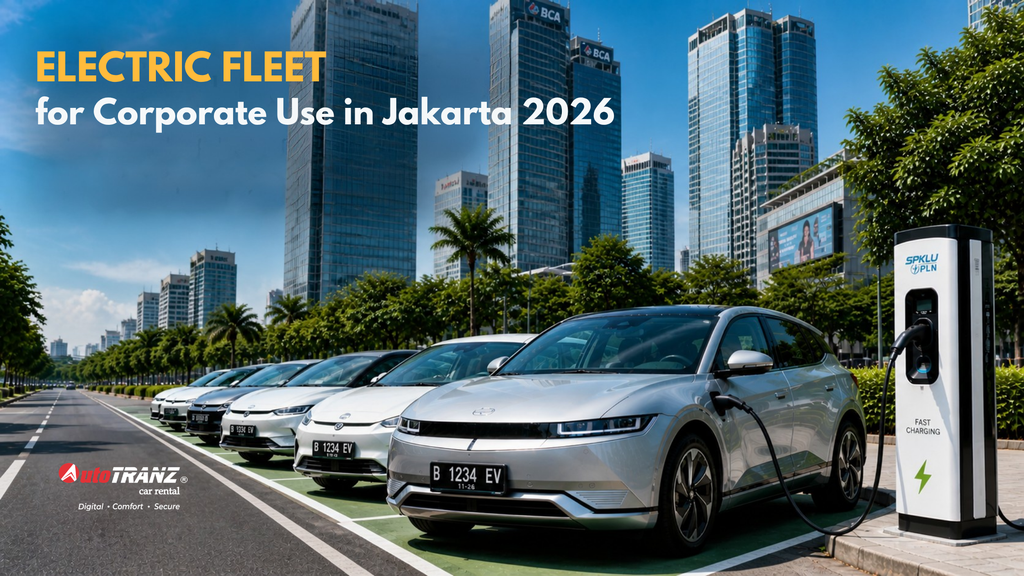
At 9:10 a.m. on a Monday in Sudirman, a GA manager (General Affairs Manager) paused a fleet renewal meeting after a new directive from direksi (company directors / board level) appeared on screen: “Evaluate EV integration for 2026.” The numbers looked convincing. Fuel savings, ESG alignment, and policy incentives all pointed in one direction. Yet the operations lead raised a different issue—how would a pengemudi (driver) handle a late return from Cikarang if no SPKLU (public EV charging station) was available nearby? That is the real conversation happening across Jakarta today. Even companies already using premium car rental for executive mobility are now asking whether kendaraan listrik (electric vehicle) can move beyond pilot projects into daily operational reality.
Jakarta EV Fleet: At a Glance
- EV adoption in Jakarta is viable for inner-city corporate routes in 2026.
- Charging infrastructure remains concentrated in central business districts.
- Operational risks include range limits, driver readiness, and route mismatch.
- A hybrid EV–ICE fleet is the most practical corporate strategy today.
THE OPPORTUNITY: WHAT IS DRIVING CORPORATE EV INTEREST IN JAKARTA RIGHT NOW
Policy is setting the direction. Indonesia’s Perpres 55/2019 continues to support EV adoption, including PPnBM (luxury goods tax — 0% for EVs under current incentive) relief that reduces upfront acquisition cost. For procurement teams, that changes the financial equation immediately. It is no longer just an environmental decision. It is a cost discussion.More importantly, EVs bring operational advantages that Jakarta companies feel every weekday. Vehicles with EV plates remain exempt from ganjil-genap restrictions. In corridors like SCBD, Sudirman, Kuningan, and Gatot Subroto, this translates into uninterrupted access during peak hours.
- Faster executive transfers
- Predictable route planning
- Reduced idle time in traffic restrictions
Even companies operating only within Jakarta’s central business zones are seeing tangible benefits. Based on industry observations, EV fleets used for repetitive daily routes show lower energy costs per kilometre and reduced mechanical servicing compared to ICE vehicles.
ESG pressure is another driver. Multinational companies in Indonesia are now required to report emissions performance annually. Transitioning even part of a mobil dinas (official company vehicle) fleet to EVs supports compliance without requiring full operational overhaul.
Then there is perception. For many corporates, EV adoption signals alignment with future mobility trends. That matters in client-facing industries.
Still, the opportunity is location-specific. It works best where infrastructure already supports it.
THE RISKS: WHAT JAKARTA FLEET MANAGERS ARE ACTUALLY WORRIED ABOUT
Charging infrastructure is uneven. While central Jakarta has reasonable SPKLU coverage, areas such as Cikarang Barat, MM2100, EJIP Industrial Park, and large parts of Tangerang Selatan still lack reliable charging points. Managing an EV armada (fleet) across these zones introduces operational friction that does not exist with conventional vehicles.
Range anxiety becomes visible the moment routes extend beyond Jakarta. Trips to Bogor, Karawang, or Subang require planning that most corporate schedules do not allow. Without guaranteed mid-route charging, delays become a real risk.
Other concerns are more subtle but equally important:
- Depresiasi (depreciation) uncertainty in Indonesia’s EV resale market
- Limited clarity on resale handling under BPKB (vehicle ownership certificate) and STNK (vehicle registration document)
- Higher insurance premiums due to evolving EV coverage standards
- Driver adaptation to regenerative braking and charging protocols
Procurement risk is another factor. Indonesia’s EV market is still developing. Some models may not remain in production long-term, and ATPM (Agen Tunggal Pemegang Merek — authorised dealer) networks vary in strength.
Before committing to a full EV fleet in 2026, most companies are asking one question: can operations remain stable if conditions change?
INFRASTRUCTURE REALITY: JAKARTA VS TANGERANG VS BEKASI IN 2026
The EV readiness gap across Greater Jakarta is significant.In DKI Jakarta, especially in SCBD, Sudirman, Kemayoran, and Pluit, SPKLU availability is relatively stable. Charging stations are increasingly integrated into office buildings, malls, and toll rest areas. For companies operating within these corridors, EV usage is manageable for daily activities.
Move outside central Jakarta, and the situation changes quickly.
- Tangerang areas like BSD City and Alam Sutera offer limited SPKLU access, mostly within commercial complexes such as AEON Mall
- Residential and industrial zones in Bintaro Jaya, Karawaci, and Serpong remain underserved
- Bekasi industrial hubs including MM2100, EJIP, and Delta Silicon have minimal charging infrastructure
Airport mobility adds complexity. The Soekarno-Hatta corridor is improving, but charging reliability is not yet consistent for back-to-back corporate transfer schedules.
Even companies with predominantly Jakarta-based operations must consider occasional cross-city travel. Without reliable SPKLU access, even the most compelling EV savings can disappear under operational delays.
COST STRUCTURE REALITY: EV VS ICE FOR CORPORATE FLEETS IN JAKARTA
Cost is where most decisions either accelerate or stop.
At first glance, EVs appear more expensive. Acquisition cost is higher, and insurance premiums for kendaraan listrik (electric vehicle) remain above standard ICE vehicles in Indonesia. However, fleet decisions are rarely based on purchase price alone. They are based on total cost of ownership across the contract period.
Over a three- to five-year cycle, the structure starts to shift.
- Energy cost per kilometre is lower than fuel
- Fewer moving parts reduce routine servicing needs
- Brake wear decreases due to regenerative systems
However, the equation changes outside these zones.
When EVs are deployed for mixed-use operations—combining Jakarta CBD with Tangerang or Bekasi routes—hidden costs emerge. Time spent locating available SPKLU (public EV charging station), longer idle periods during charging, and route inefficiencies can offset expected savings.
That is where many early projections fail.
Depreciation adds another layer of uncertainty. Unlike ICE vehicles, resale value for EVs in Indonesia is still developing. The secondary market is not yet mature, and procurement teams cannot rely on historical benchmarks for depresiasi (depreciation).
This uncertainty affects financial planning.
Even companies with strong ESG targets are now modelling multiple scenarios instead of committing to a single fleet structure. Some are comparing outright purchase against long term car rental, where cost predictability becomes more important than ownership.
Without reliable utilisation patterns, ownership carries more risk.
A structured kontrak sewa (rental contract) shifts that risk. It allows companies to test EV deployment under real operating conditions without locking capital into assets that may not align with future infrastructure improvements.
That flexibility is often underestimated.
For CFOs reviewing 2026 budgets, the question is no longer “Are EVs cheaper?” It is “Under which routes and contract structures do EVs actually reduce total cost without introducing operational risk?”
The answer is rarely universal. It is route-specific, time-bound, and dependent on how disciplined the fleet strategy is.
HYBRID FLEET STRATEGY: THE PRACTICAL MIDDLE GROUND MOST JAKARTA COMPANIES ARE CHOOSING
The most effective approach is not full transition. It is selective integration.
Most Jakarta corporates are adopting a hybrid fleet structure. EVs are deployed for predictable, high-frequency routes within central Jakarta. These include SCBD meetings, Kuningan office commutes, Gatot Subroto travel, and controlled airport transfers.
At the same time, ICE or hybrid vehicles remain in use for:
- Intercity travel
- Industrial site visits
- Long-distance field operations
Companies working with established fleet providers like AutoTRANZ are structuring long-term contracts that include both EV units for CBD use and ICE vehicles for field operations—avoiding the all-or-nothing commitment that makes full EV transition impractical for most Jakarta corporates right now.
A kontrak sewa (rental contract) provides flexibility. Businesses using corporate car rental or long term car rental models can adjust fleet composition annually based on infrastructure development and operational experience.
That flexibility matters more than early adoption.
For executive mobility and airport routes, companies can align EV deployment with premium executive vehicle usage under structured contracts: https://autotranzcarrental.com/en
EV MODELS BEING CONSIDERED FOR CORPORATE FLEETS IN INDONESIA 2026
Procurement teams are narrowing their options based on practicality, not branding.
Four models are currently leading corporate EV consideration in Indonesia. Each serves a distinct operational role.
Jakarta EV Fleet Overview
| Model | Best Corporate Use Case | Approx. Range | ATPM Service in Jakarta |
|---|---|---|---|
| Hyundai Ioniq 5 / 6 | Executive transport, airport transfers | ~450–500 km | Strong |
| BYD Atto 3 | Daily operational fleet | ~400 km | Growing |
| Wuling Air EV | Short-distance city mobility | ~200 km | Wide |
| Toyota bZ4X | Corporate executive fleet | ~450 km | Established |
Hyundai’s Ioniq models are often selected for premium mobility due to comfort and range. BYD Atto 3 fits operational needs for inner-city travel. Wuling Air EV is used for courier or messenger roles where distance is limited. Toyota bZ4X benefits from brand familiarity and a reliable dealer network.
The decision depends on route profile, driver capability, and service support—not just specifications.
Even companies planning to rent a car Jakarta for flexibility are evaluating EV models within specific operational segments rather than across their entire fleet.
CLOSING
EV adoption for Jakarta corporate fleets in 2026 is a real opportunity, but readiness depends on how and where vehicles are used. Inner-city operations already support EV integration, while outer-city routes still require conventional flexibility. The risk lies not in adopting EVs, but in committing without a structured fleet strategy.
For Jakarta and Tangerang companies exploring EV-inclusive fleet arrangements, AutoTRANZ's corporate rental team can structure a hybrid fleet consultation at no obligation — request a fleet consultation at https://autotranzcarrental.com/en/hubungi-kami.
FAQ
Q: Are EV vehicles exempt from Jakarta's odd-even (ganjil-genap) restriction in 2026?
A: EV vehicles are currently exempt from Jakarta’s ganjil-genap restriction. This allows corporate fleets to operate freely in restricted corridors such as Sudirman and Thamrin during peak hours, improving route efficiency and reducing travel delays.
Q: What is the average charging time for corporate EVs at Jakarta's SPKLU stations?
A: Charging time typically ranges from 30 to 90 minutes using fast chargers, while standard AC charging can take several hours. Fleet operators often rely on scheduled charging during idle periods or overnight parking.
Q: Is long-term car rental a better option than purchasing an EV fleet outright for Jakarta companies?
A: Long-term car rental reduces upfront capital expenditure and allows companies to adapt fleet composition over time. This flexibility is valuable in Indonesia’s evolving EV ecosystem, where infrastructure and market conditions are still developing.
Q: Does AutoTRANZ offer premium EV rental options for corporate clients in Jakarta and Tangerang?
A: AutoTRANZ supports corporate clients with EV-inclusive fleet planning and premium rental options in Jakarta and Tangerang, depending on operational feasibility and route requirements.
Related article
-
Executive Car Rental in Jakarta: Choosing the Right Mobil Direksi for Corporate Travel
Tuesday, 06 October 2026
-
Long-Term Car Rental for 3, 6, or 12 Months: Which Plan Fits Your Business?
Tuesday, 11 August 2026
-
West Java Road Trip Checklist for Premium Car Rental Customers
Wednesday, 05 August 2026