
 EN
EN
 ID
ID
Company Car Rental in Indonesia: Overlooked Contract Terms That Increase Operational Costs
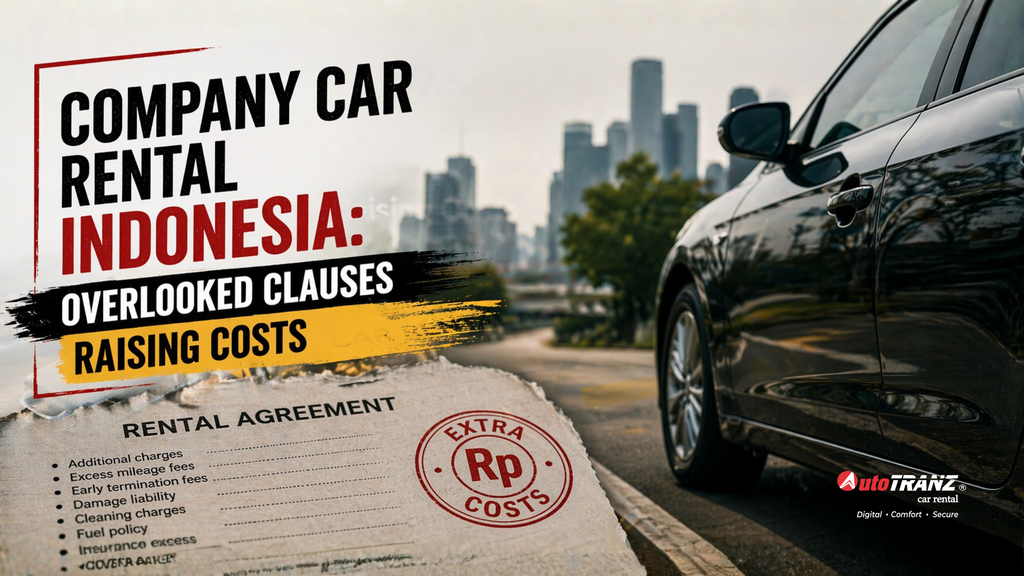
A GA manager in Jakarta signs a company car rental contract after comparing three vendors on monthly price alone. The quote looks competitive, the vehicle class is right, and the sales deck promises “all-inclusive service.” Two months later, the finance team starts seeing extra billing for downtime, driver overtime, replacement delays, and maintenance items that were assumed to be covered. This is where many procurement teams get caught. In corporate transportation, the cheapest headline rate is not always the lowest total cost. Hidden contract terms can quietly turn a manageable fleet budget into a recurring cost problem.
Quick Answer:
Hidden contract terms in company car rental in Indonesia typically increase costs through:
- Unclear maintenance coverage and excluded service items
- Driver overtime and variable cost structures
- Delayed or non-guaranteed replacement vehicles
- Mileage limits and penalty-based charges
Most cost overruns appear after contract activation, when these terms start affecting daily operations
THE MOST OVERLOOKED HIDDEN COSTS IN COMPANY CAR RENTAL
The biggest hidden costs in company car rental contracts usually appear in areas that look standard during sales negotiation but are not fully defined in the rental agreement terms.
Maintenance exclusions are one of the most common. A vendor may say maintenance is included, but the contract may exclude brake pads, battery replacement, tires, fluids, or wear-and-tear items. For a field sales fleet in Bekasi or Jakarta, those costs add up quickly because the vehicles run daily and spend more time in traffic.
Driver overtime and HR costs are another problem. Some corporate car rental contracts include a driver, but not overtime after office hours, weekend assignments, or waiting time during client visits. In practice, this can increase monthly spending, especially for executives or operational teams with irregular schedules.
Replacement vehicle delays also create indirect losses. If a unit is under repair and the contract does not guarantee a replacement unit within a clear time frame, the company may have to rent another car separately or let staff lose productive time.
Insurance limitations can be expensive too. A contract may list insurance as “included” but still leave the company exposed to deductibles, excess claims, or exclusions for certain damage types.
Fuel policy traps are often overlooked. Some vendors use a full-to-full rule, while others charge administrative adjustments for fuel discrepancies. For a busy company car used by a sales or site team, even small misunderstandings can become monthly leakage.
CONTRACT CLAUSES THAT SILENTLY INCREASE MONTHLY SPENDING
Many GA teams focus on price per unit, but the real budget risk sits inside the clause structure. In an operational car rental contract, small wording differences can change the monthly cost profile.
Minimum usage clauses are a frequent example. A vendor may lock the company into a minimum number of vehicles or a minimum monthly billing amount. If one department scales down usage, the company still pays the same base fee.
Early termination penalties can also be heavy. Some fleet contract clauses require the customer to pay several months of remaining fees if the contract ends early. This creates procurement risk when project timelines change or headcount is reduced.
Kilometer limits are another hidden cost driver. A contract may look affordable until the fleet exceeds the included mileage. For sales-heavy teams in Jakarta or project teams traveling to Bogor and Bekasi, extra kilometers can quietly increase the monthly invoice.
Downtime charges matter more than many buyers expect. If the vehicle is unavailable during repair but still billed, the company pays for a unit it cannot use. That is a direct hit to operational efficiency.
Service response SLAs are equally important. If the vendor promises repair support but does not define response time, the company can lose days waiting for action. In fleet budgeting, delayed service is not just an inconvenience; it is cost leakage.
PROCUREMENT RED FLAGS IN COMPANY CAR RENTAL CONTRACTS
Beyond standard pricing and service scope, experienced GA and procurement teams in Indonesia often look for early warning signs inside a company car rental proposal. These red flags usually indicate future cost escalation or operational friction.
One major red flag is overly simplified pricing. If a vendor provides a single “all-in” number without a detailed breakdown, it becomes difficult to validate what is actually included. In many cases, this leads to hidden fees appearing later under different billing categories such as admin charges, emergency service costs, or non-standard maintenance.
Another issue is unclear responsibility allocation. In some corporate car rental agreements, the line between vendor responsibility and client responsibility is blurred. For example, who pays if a vehicle is unavailable due to delayed servicing? Who absorbs the cost of driver replacement? Without clear answers, the company often ends up covering the gap.
Inconsistent contract language is also a risk. Procurement teams should watch for clauses that contradict each other — for instance, a section that promises full maintenance coverage, while another section limits specific components. These inconsistencies are often overlooked during negotiation but become critical during claims or disputes.
For companies operating under operational car rental models, another warning sign is the absence of performance tracking. If the contract does not include reporting on vehicle uptime, service response time, or maintenance frequency, it becomes difficult to measure vendor performance. Without data, cost inefficiencies remain hidden.
Finally, limited flexibility clauses can create long-term financial pressure. Contracts that lock companies into rigid terms without adjustment options — especially in long-term agreements — increase risk when business needs change. This is particularly relevant for companies scaling operations in Bekasi or expanding branch coverage toward Bogor.
For procurement leaders, identifying these risks early is not just about avoiding problems. It is about ensuring that the company car strategy supports operational efficiency instead of quietly draining the budget over time.
LONG-TERM CAR RENTAL VS SHORT-TERM CONTRACTS: COST IMPACT
For companies that need predictable budgeting, long-term car rental usually reduces cost volatility better than short-term arrangements. The reason is simple: a longer contract typically allows clearer monthly pricing, more stable maintenance planning, and better visibility on replacement support and service scope.
Short-term contracts may look flexible, but they often carry higher month-to-month fluctuation. The company may face different rates, variable driver charges, higher admin fees, or limited repair commitment. That creates budgeting problems for finance teams that need stable operating costs.
By contrast, a structured long-term contract can bundle maintenance, service schedules, and replacement rules into a single recurring fee. That makes it easier for procurement to compare vendors on total cost, not just the sticker price. At AutoTRANZ, this is exactly why the Long-Term Car Rental model is often discussed by buyers who want clearer cost control rather than temporary fixes.
The real advantage is not only lower cost, but lower uncertainty. For GA and finance teams, predictability is often more valuable than a slightly cheaper rate that comes with surprise charges later.
LOCATION-BASED COST DIFFERENCES: BEKASI VS BOGOR VS JAKARTA
Location matters in fleet pricing because vehicle usage patterns are not the same across Jakarta, Bekasi, and Bogor.
In Bekasi car rental scenarios, especially for industrial zones such as Cikarang and MM2100, vehicles often face heavy daily usage, long waiting times, and frequent site mobility. That increases wear, service frequency, and the chance of overtime if the unit also supports operational staff beyond office hours. For this reason, contracts used in Bekasi should be reviewed carefully for maintenance coverage and replacement turnaround.
In Bogor car rental use cases, road conditions, hilly terrain, and longer inter-area travel can create different maintenance impacts. Suspension, brake wear, and fuel consumption may be more relevant than in a city-only route profile. Companies using vehicles for field operations or branch support around Bogor should check whether the rental contract treats this usage as standard or premium mileage.
In Jakarta, traffic density creates another layer of cost. Long idling time, extended driver hours, and schedule unpredictability can all affect the driver cost structure and service usage. Jakarta-based teams also need to watch SLA language because delays are more expensive in a congested metro environment.
For corporate buyers, location is not just logistics. It changes the true economics of company car rental and should shape how the contract is written.
COMPARISON TABLE
| Cost Factor | Transparent Rental Contract | Risky Rental Contract |
|---|---|---|
| Maintenance Coverage | Full included | Limited exclusions |
| Replacement Vehicle | Guaranteed | Subject to availability |
| Driver Cost | Fixed | Variable |
| Downtime Cost | Covered | Charged separately |
| Contract Flexibility | High | Restricted |
HOW CORPORATE CAR RENTAL CONTRACTS SHOULD BE STRUCTURED
A well-structured corporate car rental agreement should remove ambiguity before the vehicle is deployed. The goal is not just to secure a low monthly rate, but to protect the company from cost surprises.
First, the SLA must be clear. Response times for breakdowns, service requests, and replacement unit delivery should be written in measurable terms. A vague promise is not enough for a company that depends on fleet availability every day.
Second, the contract should show a full cost breakdown. That means the invoice logic, driver terms, maintenance coverage, kilometer policy, fuel treatment, and any extra fees must be listed in plain language. When a quote is “all-in,” the vendor should still define what “all-in” means.
Third, maintenance inclusions must be specific. GA procurement teams should ask whether the plan includes periodic service, wear-and-tear items, tires, insurance excess, and emergency assistance. This is where many fleet contract clauses create avoidable leakage.
Fourth, the replacement vehicle policy should be explicit. A company should know how fast a substitute unit is delivered, whether it is the same class, and whether there is a cost if the original vehicle is unavailable for an extended period.
Finally, billing transparency matters. Monthly invoices should match the agreement without manual interpretation. In professional fleet management, clarity saves more money than negotiation pressure.
CLOSING
Pada akhirnya, hidden contract terms matter more than the headline price. A lower monthly rate is useless if the agreement adds costs through maintenance gaps, delayed replacements, mileage overages, or unclear penalty terms. For procurement and GA teams, the safest approach is to review the full rental agreement terms before signing, not after the first invoice arrives.
For companies reviewing company car rental contracts, AutoTRANZ provides a no-obligation consultation — request a fleet consultation.
FAQ
Q: What are the hidden costs in company car rental in Indonesia?
A: Hidden costs usually come from maintenance exclusions, driver overtime, replacement unit fees, mileage limits, penalty charges, and insurance claims that are not fully covered by the contract.
Q: Is corporate car rental more cost-effective than buying company vehicles?
A: For many companies, yes. Corporate car rental is more cost-effective when businesses want fixed costs without handling depreciation, maintenance, taxes, and fleet downtime risks.
Q: What should be checked in an operational car rental contract?
A: Check service SLAs, maintenance coverage, mileage limits, fuel policy, driver overtime costs, downtime charges, and vehicle replacement terms. Everything should be clearly written in the contract.
Q: Bekasi vs Bogor car rental — what is the difference for companies?
A: Bekasi usage is typically heavier due to industrial and commuter activity, while Bogor is more affected by route distance, terrain, and travel conditions. These differences impact maintenance costs and vehicle wear-and-tear.